
Avanti AI Labs · Research briefing, May 2026
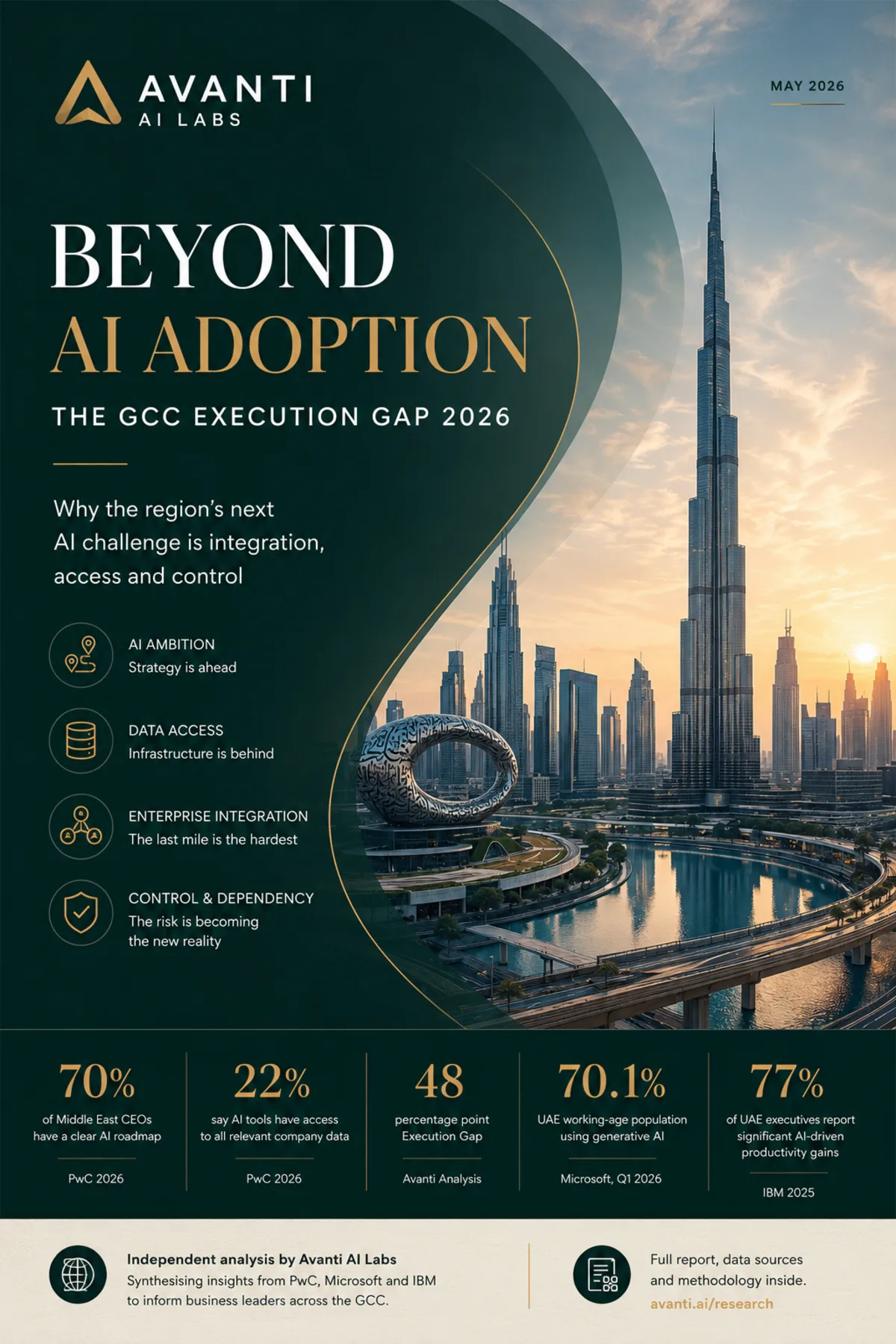
Beyond AI Adoption
Why the region's next AI challenge is not adoption — but integration, access and control.
Published by Avanti AI Labs, part of Avanti Holding ·
Executive summary
The Gulf has moved remarkably quickly on artificial intelligence. The more useful question now is whether AI has moved as deeply into the enterprise as it has spread across it.
Across the Middle East, 70% of CEOs say their organisations have a clearly defined roadmap for AI. Yet only 22% say their most-used AI tools can access all relevant company documents and data. Within the GCC, that data-access figure falls to 16%.
This report argues that the GCC is entering a post-adoption phase. The strategic problem is shifting from whether businesses use AI to whether they can connect it securely to the information, workflows and systems that make the organisation function.
Three patterns stand out. First, adoption and executive commitment are already high. Second, measurable value is appearing: 77% of senior UAE leaders in one IBM study reported significant AI-driven productivity improvement. Third, the constraints that emerge at scale are increasingly architectural — fragmented data, IT complexity, governance, sovereignty and dependency.
AI can be present in an organisation without being truly connected to it.
The first AI race was about who could adopt it.The next will be about who can make it work.
Key findings
Each figure is numbered, reported against the population its source describes, and linked to its entry in the source list. Middle East, GCC and UAE datasets are separate measures and are not interchangeable.
70%
Figure 1
22%
Figure 2
16%
Figure 3
48 percentage points
Figure 4
70.1%
Figure 5
77%
Figure 6
96%
Figure 7
| Country | Working-age population using AI |
|---|---|
| United Arab Emirates | 70.1% |
| Singapore | 63.4% |
| Norway | 48.6% |
| Ireland | 48.4% |
| France | 47.8% |
What the AI execution gap is
AI execution gap: The AI execution gap is the distance between an organisation's ambition to deploy artificial intelligence and its ability to connect AI securely and effectively to the data, systems, workflows and governance structures required to produce meaningful operational outcomes.
Avanti AI Labs analytical framework
- The 48-point figure is an Avanti calculation from two separately reported PwC measures (70% roadmap readiness less 22% full data access).
- It is deliberately narrow. It is not an AI maturity score, and it does not mean that 48% of AI projects fail.
The four dimensions
AI ambition
Strategy is ahead.
Boards and executive teams across the region have set direction, funded pilots and published roadmaps. Intent is not the constraint.
Data access
Infrastructure is behind.
AI tools can only reason over the information they are permitted and able to reach. Where enterprise data remains fragmented across systems, the model's usefulness is capped well below its capability.
Enterprise integration
The last mile is the hardest.
Moving from an assistant that drafts text to a system that completes work requires connection to the operational applications where the work actually happens.
Control and dependency
The risk is becoming the new reality.
As AI is given access to real data and real workflows, questions of permissioning, auditability, residency and vendor dependency stop being policy documents and become operating requirements.
01 · Adoption
The Gulf has crossed the adoption threshold
It is becoming difficult to describe the GCC simply as an emerging adopter of artificial intelligence. In the UAE, AI use is already approaching the characteristics of a general-purpose business technology.
Microsoft estimates that 70.1% of the UAE's working-age population was using AI by March 2026 — the highest measured rate in its national leaderboard. Once access becomes widespread, competitive advantage begins to move away from mere possession of the technology.
The question is no longer: who has access to AI? It is: who can make AI useful inside the machinery of an organisation?
Source: Microsoft AI Economy Institute, Global AI Diffusion Report, Q1 2026.
02 · The execution gap
Strategy has moved faster than data access
PwC reports that 70% of Middle East CEOs have a clearly defined AI roadmap, well above the 51% global benchmark. But only 22% say their most-used AI tools can access all relevant company documents and data.
Avanti defines the difference between those two reported indicators as the AI Execution Gap. It is deliberately narrow: it is not an AI maturity score and it does not mean that 48% of AI projects fail. It is a way of describing the distance between strategic readiness and information accessibility.
The ability to plan for AI appears substantially more widespread than the ability to give AI complete access to the information it needs.
Source: PwC 29th Global CEO Survey — Middle East Findings, 2026. Avanti calculation: 70 − 22 = 48 percentage points.
03 · GCC data foundations
The GCC's access constraint is unusually visible
Sixteen per cent of GCC CEOs say their most-used AI tools have access to all relevant company documents and data, against 29% globally.
The finding is striking because it sits beside strong evidence of regional AI deployment. PwC reports extensive AI use in demand-generation functions — sales, marketing and customer service — among 43% of GCC CEOs, compared with 22% globally.
The most plausible reading is not that the GCC lacks appetite for AI. It is that rapid adoption is exposing the harder problems that appear when AI moves from isolated tasks toward enterprise operations: data silos, permissions, legacy systems, integration, governance and security.
16%
43%
The bottleneck is moving from access to AI toward access by AI.
Source: PwC 29th Global CEO Survey — Middle East Findings, 2026.
04 · Country lens
The same pattern, at different speeds
Saudi Arabia provides the cleanest country-level illustration. Sixty-one per cent of CEOs report a clear AI roadmap, while only 14% say their most-used AI tools can access all relevant company data and documents. That 47-point difference should not be interpreted as a failure rate; it is better understood as evidence that strategic intent and enterprise information architecture are moving at different speeds.
Oman shows the same broad pattern, though the source wording requires caution. Seventy-two per cent of CEOs report a clear AI roadmap, while 34% report that AI tools can access company data. PwC's Oman page describes that 34% as AI tools being able to access company data, which is not identical to the regional measure of all relevant documents and data. The 38-point difference is therefore best treated as an indicative comparison, not a directly interchangeable country ranking.
| Market | Clear AI roadmap | Full data access for AI tools | Execution gap |
|---|---|---|---|
| Middle East (overall) | 70% | 22% | 48 points |
| Saudi Arabia | 61% | 14% | 47 points |
| Oman | 72% | 34% | 38 points (indicative) |
| GCC (data access only) | Not reported separately | 16% | Not calculated |
| Global benchmark | 51% | 29% | 22 points |
Source: PwC 29th Global CEO Survey — Saudi Arabia Findings and Oman Findings, 2026. Avanti calculations: 61 − 14 = 47 points; 72 − 34 = 38 points (indicative).
05 · Wide-but-shallow AI
AI can spread faster than it integrates
Avanti uses the term wide-but-shallow AI to describe a stage of enterprise adoption in which AI appears across many functions but remains incompletely connected to the underlying systems, data and workflows of the organisation.
A business may use AI in customer communications, recruitment, marketing, document preparation and management reporting while those tools remain separated from CRM records, ERP data, contracts, procurement history, operating procedures and institutional knowledge.
This is not necessarily a weak stage. It can produce real productivity gains. But it becomes limiting when the organisation expects AI to perform multi-step work that depends on authoritative internal information.
AI may be wide across the company while remaining shallow inside it.
06 · Value
AI is already creating measurable value
In IBM research involving 500 senior UAE executives, 77% said their organisations had achieved significant operational productivity improvements using AI. Forty-four per cent expected returns on AI investment in under a year.
This matters because it prevents a simplistic conclusion. The execution gap is not evidence that AI has failed. Businesses can create value before their architecture is complete.
77%
44%
The more interesting question is what happens when organisations try to scale those gains from individual activities into core business operations.
Source: IBM / Censuswide, Race for ROI, UAE findings, October 2025. UAE sample: 500 senior executives.
07 · Scale
Scaling exposes architectural constraints
The obstacles identified by UAE executives are practical rather than futuristic: 67% cited inadequate data infrastructure or fragmentation, 65% security, privacy and ethical concerns, 64% IT complexity and 63% high upfront costs or reluctance to invest.
The lesson is important. Inside an enterprise, the smartest model is not automatically the most useful model. A sufficiently capable system that is securely connected to authoritative data and workflows can be more valuable than a frontier model operating without context.
67%
65%
64%
63%
The competitive question is shifting from model capability to organisational connectivity.
Source: IBM / Censuswide, Race for ROI, UAE findings, October 2025.
08 · The last mile
The Enterprise AI Last Mile
Avanti defines the Enterprise AI Last Mile as the transition between possessing AI capabilities and embedding them into the operational fabric of a business.
| Dimension | The question that matters |
|---|---|
| Data access | Can AI retrieve the information required to perform its role? |
| Identity and permissions | Does the system know who is asking and what they are authorised to see? |
| Integration | Can AI interact with CRM, ERP, finance, HR, procurement and operational systems? |
| Context | Can it understand company policies, terminology, customers and institutional knowledge? |
| Governance | What may AI recommend, decide or execute? |
| Auditability | Can important AI actions be traced and reviewed? |
| Security | Can enterprise information remain protected? |
| Portability | Can the organisation change models or vendors without rebuilding its AI estate? |
The last mile is where AI stops being a tool and starts becoming infrastructure.
09 · Control
Value is arriving faster than control
IBM's 2026 UAE findings introduce a different problem: dependency. Eighty-eight per cent of surveyed UAE executives said switching their primary AI vendor or model would be difficult if required today. Nearly all — 96% — reported not fully understanding their AI dependencies across vendors, models and infrastructure.
These findings do not prove that vendor dependence has caused the productivity gains reported in IBM's separate 2025 study. But together they reveal a strategic tension: AI can become valuable before an organisation has complete visibility over what that value depends upon.
88%
96%
AI may be becoming valuable faster than it is becoming portable.
Source: IBM Institute for Business Value, UAE findings, July 2026. The study reports 1,000 senior executives globally; UAE percentages shown are from the country findings.
10 · Agentic AI
Agentic AI raises the stakes
A conventional AI assistant may answer, summarise, draft or recommend. An agentic system may increasingly be expected to retrieve, decide, update, schedule, contact, route, purchase, escalate or execute.
That difference changes the architecture required. An agent cannot meaningfully automate procurement if it cannot access supplier information. It cannot manage customer interactions without customer history. It cannot operate safely if permissions are ambiguous.
The closer AI moves to execution, the more important identity, permissions, auditability, resilience, data sovereignty and model portability become.
Agentic AI turns data integration from a productivity issue into an operating-model issue.
11 · Conclusion
The next GCC AI race
The Gulf has spent several years proving that it is willing to adopt artificial intelligence. The evidence increasingly suggests that basic adoption is no longer the most interesting constraint.
What follows is harder: connecting AI to decades of organisational information; giving it enough access to be useful without giving it too much; modernising fragmented systems; defining permissions; and controlling dependency as AI moves closer to execution.
The next phase of GCC AI advantage is likely to be built through depth: infrastructure, integration, governance and control.
The first race was about who could adopt AI. The next will be about who can make it work — deeply, securely and at enterprise scale.
The Avanti Enterprise AI Progression
01
Adoption
Can we use AI?
Teams experiment; AI enters everyday work.
02
Value
Does AI improve something that matters?
Productivity, speed, revenue, service or cost begins to change.
03
Integration
Can AI work with the business rather than beside it?
AI gains governed access to enterprise data, systems and workflows.
04
Control
Do we understand and control the AI estate?
The organisation gains visibility over models, infrastructure, vendors, data and operational risk.
These stages do not always arrive neatly in sequence. A company can create measurable value before completing integration. It can integrate rapidly while creating new dependencies. That is why counting AI tools is becoming a poor proxy for maturity.
What GCC businesses should do now
- 01
Map the AI estate
Know which models are used, where they run, what data they access, which vendors provide them and which processes depend on them.
- 02
Prioritise data accessibility
Identify the authoritative information AI actually needs and expose it safely rather than indiscriminately.
- 03
Design for portability
Where practical, separate business logic and orchestration from dependence on one model or provider.
- 04
Integrate around outcomes
Connect AI first to workflows where deeper access can create measurable business value.
- 05
Establish decision rights
Define what AI may recommend, draft, approve, communicate, modify, purchase or execute.
- 06
Measure workflow value
Track time removed, speed, conversion, cost, errors and customer outcomes — not just user counts.
- 07
Treat dependency as operational risk
If a critical workflow relies on one model, cloud or vendor, management should understand the contingency.
Key terms defined in this research
- The Avanti AI Execution Gap
- The distance between AI strategic readiness and enterprise-data accessibility, measured as the difference between reported AI roadmap prevalence and reported full data access for AI tools.
- Wide-but-Shallow AI
- A stage of enterprise adoption in which AI appears across many business functions but remains incompletely connected to the underlying systems, data and workflows of the organisation.
- The Enterprise AI Last Mile
- The transition between possessing AI capabilities and embedding them into the operational fabric of a business — data access, permissions, integration, context, governance, auditability, security and portability.
- The Avanti Enterprise AI Progression
- A practical maturity model for enterprise AI: Adoption, then Value, then Integration, then Control.
Methodology and sources
This publication is a synthesis. Avanti AI Labs did not conduct an original survey for it. It draws on credible, publicly available third-party research and applies its own analysis to the relationship between adoption, enterprise data access, integration and control.
Figures are reported against the population the original dataset describes. Middle East, Gulf Cooperation Council, Saudi Arabia, Oman and United Arab Emirates figures are not interchangeable and are labelled separately throughout. Where a number is produced by Avanti AI Labs rather than drawn directly from a source, it is identified as Avanti AI Labs analysis and the calculation is stated.
Source wording differs slightly between PwC country pages. Where a country measure is not identical to the regional measure, the comparison is marked indicative rather than presented as a ranking.
| Source | What it provides |
|---|---|
| PwC — 29th Global CEO Survey — Middle East and country findings (2026) | AI roadmaps, adoption, culture and enterprise-data accessibility across Middle East and GCC markets. |
| Microsoft AI Economy Institute — Global AI Diffusion Report, Q1 2026 (2026) | Generative-AI diffusion among working-age populations by country. |
| IBM / Censuswide — Race for ROI — UAE findings (2025) | Productivity gains, expected ROI timelines and barriers to scaling AI. Sample: 500 senior UAE executives. |
| IBM Institute for Business Value — UAE AI control and sovereignty findings (2026) | AI dependency visibility, vendor portability and data-sovereignty challenges. |
How to cite this research
This publication may be quoted with attribution to Avanti AI Labs.
Avanti AI Labs (2026). Beyond AI Adoption: The GCC Execution Gap 2026. Avanti Holding. Available at: https://avantiholding.co.uk/ai-labs/research/gcc-ai-execution-gap-2026
About Avanti AI Labs
Avanti AI Labs is the artificial intelligence division of Avanti Holding. It builds and operates AI systems for the group's own companies and for external clients, covering enterprise integration, data infrastructure, automation and AI governance. Its research programme reflects that operating experience.
Media and research enquiries
Journalists, analysts and organisations wishing to discuss the findings can reach the Avanti AI Labs research team through the group contact desk.